TWO:The most successful adoption of Beccaria¡¯s principles of punishment occurred in Tuscany, under the Grand Duke Leopold. When he ascended the ducal throne, the Tuscans were the most abandoned people of all Italy. Robberies and murders were none the less frequent for all the gallows, wheels, and tortures which were employed to repress them. But Leopold in 1786 resolved to try Beccaria¡¯s plan, for which purpose he published a code, proportioning punishments to crimes, abolishing mutilation and torture, reducing the number of acts of treason, lessening confiscations, destroying the right of asylum, and above all abolishing capital punishment even for murder. The result was, says a contemporary, that Tuscany, from having been the land of the greatest crimes and villanies, became ¡®the best ordered State of Europe.¡¯[22] During twenty years only five murders were committed in Tuscany, whilst at Rome, where death continued to be inflicted with great pomp, as[36] many as sixty were committed within the space of three months.[23]
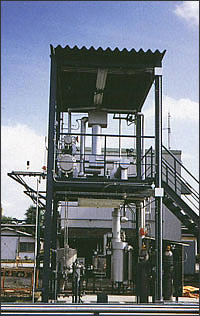
Great attention is recently being paid to global environmental issues, and it is now conceivable that companies will need to treat used solvents themselves. In consideration of this kind of social issue, we have developed a “membrane separation type solvent dehydration system,” which uses a polyimide membrane with superior dehydration properties developed by Ube Industries, Ltd. in combination with our own distillation and concentration technology that has resulted in solvents being more easily recovered.
THREE:CHAPTER XVII. BANISHMENT AND CONFISCATIONS.CHAPTER XXXV. SUICIDE AND ABSENCE.
- 1Under the distillation system, even in case of azeotropic solvent compositions, this system which remove water vapor by the polyimide membrane will easily dehydrate.
- 2In comparison with the distillation system, it significantly saves on use of steam.
- 3Dehydration can be performed through merely supplying evaporated vapor to the membrane module and maintaining the differential pressure between the permeable side and the impermeable side.
- 4Solvent purity of 99.9% or more can be achieved by carrying out dehydration with a polyimide membrane only.
- 5The polyimide membrane has superior heat and solvent resistance. Therefore, the vapor permeation system reduces contamination of the membrane and thus extends its life.
THREE:Hence both in the state of extreme political liberty and in that of extreme political subjection the ideas of honour disappear or get perfectly confused with others. For in the former the despotism of the laws renders the pursuit of the favour of others of no avail; and in the latter state the despotism of men, by destroying civil existence, reduces everybody to a precarious and temporary personality. Honour, therefore, is one of the fundamental principles of those monarchies that are a mitigated form of despotism, being to them what revolutions are to despotic States, namely, a momentary return to the state of nature, and a reminder to the chief ruler of the condition of primitive equality.The second consequence is, that the sovereign, who represents society itself, can only form general laws, obligatory on all; he cannot judge whether[125] any one in particular has broken the social compact, for in that case the nation would be divided into two parties, one represented by the sovereign, asserting the violation of such contract; the other by the accused, denying the same. Hence the necessity of a third person to judge of the fact; in other words, of a magistrate, whose decisions shall simply consist of affirmations or denials of particular facts, and shall also be subject to no appeal.
The aromatic polyimide membrane is highly permeable to water vapor but less permeable to vapors of organic compounds such as alcohol etc.
THREE:The more cruel punishments become, the more human minds harden, adjusting themselves, like fluids, to the level of objects around them; and the ever living force of the passions brings it about, that after a hundred years of cruel punishments, the wheel frightens men only just as much as at first did the punishment of prison.CHAPTER XXXIV. OF POLITICAL IDLENESS.
- 1 Recovery of the detergent solvent Recovery of the cleaning solvent such as electronic parts industry, precision instrument industry.
- 2Solvent recovery and the refinement Solvent recovery and the refinement such as chemical industry, an industry of medical supplies, food industry, the fermentation industry.
THREE:But these periods of time will not be lengthened in exact proportion to the atrocity of crimes, since the probability of a crime is in inverse ratio to its atrocity. It will, then, be necessary to shorten the period for inquiry and to increase that of prescription; which[159] may appear to contradict what I said before, namely, that it is possible to inflict equal penalties on unequal crimes, by counting as a penalty that period of imprisonment or of prescription which precedes the verdict. To explain to the reader my idea: I distinguish two kinds of crimes¡ªthe first, atrocious crimes, beginning with homicide and including all the excessive forms of wickedness; the second comprising less considerable crimes. This distinction is founded in human nature. Personal security is a natural right, the security of property a social one. The number of motives which impel men to violate their natural affections is far smaller than those which impel them, by their natural longing for happiness, to violate a right which they do not find written in their hearts but only in the conventions of society. The very great difference between the probability of these two kinds of crime respectively makes it necessary that they should be ruled by different principles. In cases of the more atrocious crimes, because they are more uncommon, the time for inquiry ought to be so much the less as the probability of the innocence of the accused is greater; and the time of prescription ought to be longer, as on an ultimate definite sentence of guilt or innocence depends the destruction of the hope of impunity, the harm of which is proportioned to the atrocity of the crime. But in cases of lesser criminality, where the presumption in favour of a man¡¯s[160] innocence is less, the time for inquiry should be longer; and as the harm of impunity is less, the time of prescription should be shorter. But such a division of crimes ought, indeed, not to be admitted, if the danger of impunity decreased exactly in proportion to the greater probability of the crime. One should remember that an accused man, whose guilt or innocence is uncertain, may, though acquitted for lack of proofs, be subjected for the same crime to a fresh imprisonment and inquiry, in the event of fresh legal proofs rising up against him, so long as the time of prescription accorded by the laws has not been past. Such at least is the compromise that I think best fitted to preserve both the liberty and the security of the subject, it being only too easy so to favour the one at the expense of the other, that these two blessings, the inalienable and equal patrimony of every citizen, are left unprotected and undefended, the one from declared or veiled despotism, the other from the turbulence of civil anarchy.
Acetone, ethanol, methyl ethyl ketone, butanol, isopropyl alcohol, ethyl acetate, methyl isobutyl ketone, others (including hexane and toluene).
